How to Sell Design Asset Subscriptions on Shopify
Sell fonts, brushes, presets, mockups and stock photos on Shopify as a download pass, a membership or a monthly pack: which one fits, and a worked $15 setup.
By the Content Vault team

Most guides to selling design assets on Shopify stop at the one-time download. A buyer pays once for a font or a brush pack, and you start again with the next buyer. A subscription works differently. Customers pay every month or every year for a set number of downloads from your catalogue, every asset you make, or a new pack on a schedule.
This guide shows how to sell design asset subscriptions on Shopify with Content Vault: fonts, icons, illustrations, mockups, textures and brushes, photo presets and LUTs, 3D models and stock photos. It covers which subscription model fits your assets, a full setup with a price example, how subscribers get their files, and how to protect them. Each step says which Content Vault plan it needs. If you sell planners, Canva templates or document templates, our template subscription guide covers those.
Can You Sell Design Asset Subscriptions on Shopify?
Yes. Shopify runs the checkout and takes each renewal payment. What it doesn't do on its own is decide which files a subscriber can download, keep count of their downloads, and end their access when they cancel. That's the job of a digital subscription app.
Without one, a common workaround is to join apps together: a subscription app for the billing and a download app for the files, and often a third app to lock content when someone cancels. That's several apps to keep in sync.
Content Vault does the billing, the file delivery and the access rules in one app. Subscribers sign up through your normal Shopify checkout and manage their subscription from their customer account page. On Library Access and Content Drip, you can also let them pause or skip.
Three Ways to Sell Design Assets as a Subscription
Content Vault has three subscription types. Each one suits a different kind of design asset business.
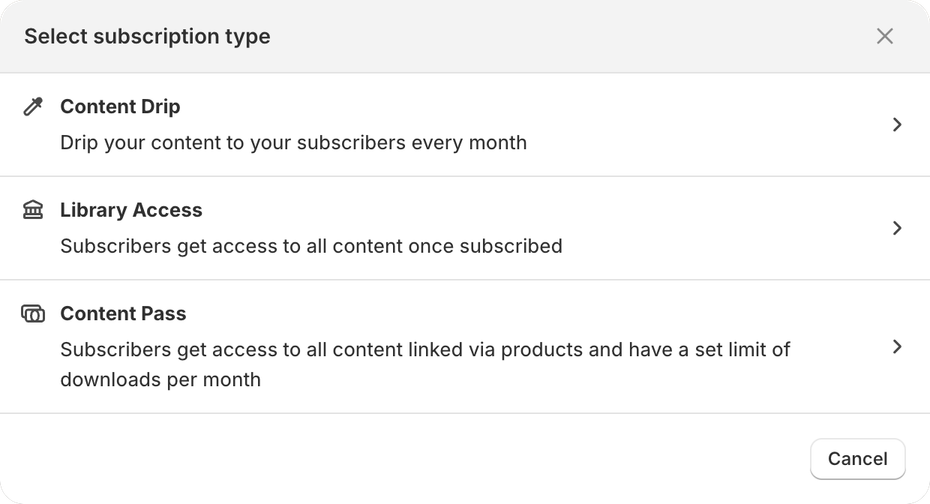
| Your idea | Content Vault type | What subscribers get |
|---|---|---|
| A download pass, like a stock site | Content Pass | A set number of downloads that refills on a schedule |
| An all-access membership | Library Access | Every asset in their plan, right away |
| A monthly pack club | Content Drip | A new pack on a schedule you set |
A Download Pass: Content Pass
Content Pass gives subscribers a download allowance, such as 5 downloads every 30 days, across the files you link to it. The allowance refills on its own schedule. The help center calls it a Shutterstock-style plan and suggests it for stock photos and design assets. It fits:
- Stock photos and textures
- Mockups, icon sets and illustration packs
- Fonts, where subscribers pick the families they need
- A big catalogue where each subscriber wants only part of it
With Content Pass, you connect files to products in your store, so each pack keeps its own product page and previews. Pass holders get a download button on those pages. Re-downloading a file they already have doesn't count against their allowance by default, and you can let unused downloads roll over to the next period.
Content Pass has fewer settings than the other two. It has no per-file or IP download limits, and subscribers can't pause or skip. If you want those, choose Library Access or Content Drip.
An All-Access Membership: Library Access
Library Access gives subscribers every file in their plan as soon as they subscribe. It fits:
- A type foundry's full font collection
- Every brush set, preset pack or LUT pack you've made
- A membership where the library grows every month
Files you connect to a plan later reach that plan's existing subscribers too. You can also run more than one plan, each with its own files. For example, a Brushes plan with just your brush sets and an All-Access plan with everything.
A Monthly Pack Club: Content Drip
Content Drip sends subscribers new content on a schedule: every month on a day you choose, or every set number of days. Each release can hold one pack or several files. It fits:
- A brush club with a new brush set every month
- A monthly preset or LUT pack
- Seasonal textures, mockups or illustrations
By default, each subscriber starts at the first release and moves through the series from their own signup date. With monthly releases, you can instead turn on Send content by month of subscription. Then everyone gets the same month's pack, and new subscribers don't get earlier months. That suits seasonal packs, like autumn textures in October.
Not Sure? Run Two
You can run more than one subscription. For example, a monthly brush club plus a download pass for your back catalogue. Pay As You Go, which has no monthly fee, allows two subscriptions, so you can test both. The help center's Which subscription type should I choose? compares the three in more detail.
How to Set Up a Design Asset Pass: A Worked Example
Say you sell Procreate brush sets, paper textures and mockups. You have 120 packs in your store, each with its own product page and preview images, and you add new ones every month. You want to sell a pass for $15 a month that gives 5 downloads every 30 days, so subscribers pick the packs they want.
Step 1: Create the Pass Product
In Shopify, create one product for the pass, such as "Design Asset Pass", and give it a price of $15. This is the product people buy to subscribe. Your packs keep their own product pages.
Step 2: Create a Content Pass Subscription
Go to Apps → Content Vault → Subscriptions and click Create new Subscription. (In your Shopify admin, Content Vault is listed as Digital Subscriptions.) Choose Content Pass. Give the subscription a name, which only you see, then click Select product and add your pass product.
Step 3: Set Up the Plan
Each plan is a tier with its own name, price and billing frequency. Plan names are what subscribers see, so keep them clear, like "Monthly". Set the Monthly plan to bill every 1 month. It uses the product's $15 price.
Billing and the allowance are set separately. The plan bills every month, and the allowance refills on its own schedule.
Step 4: Set the Download Allowance
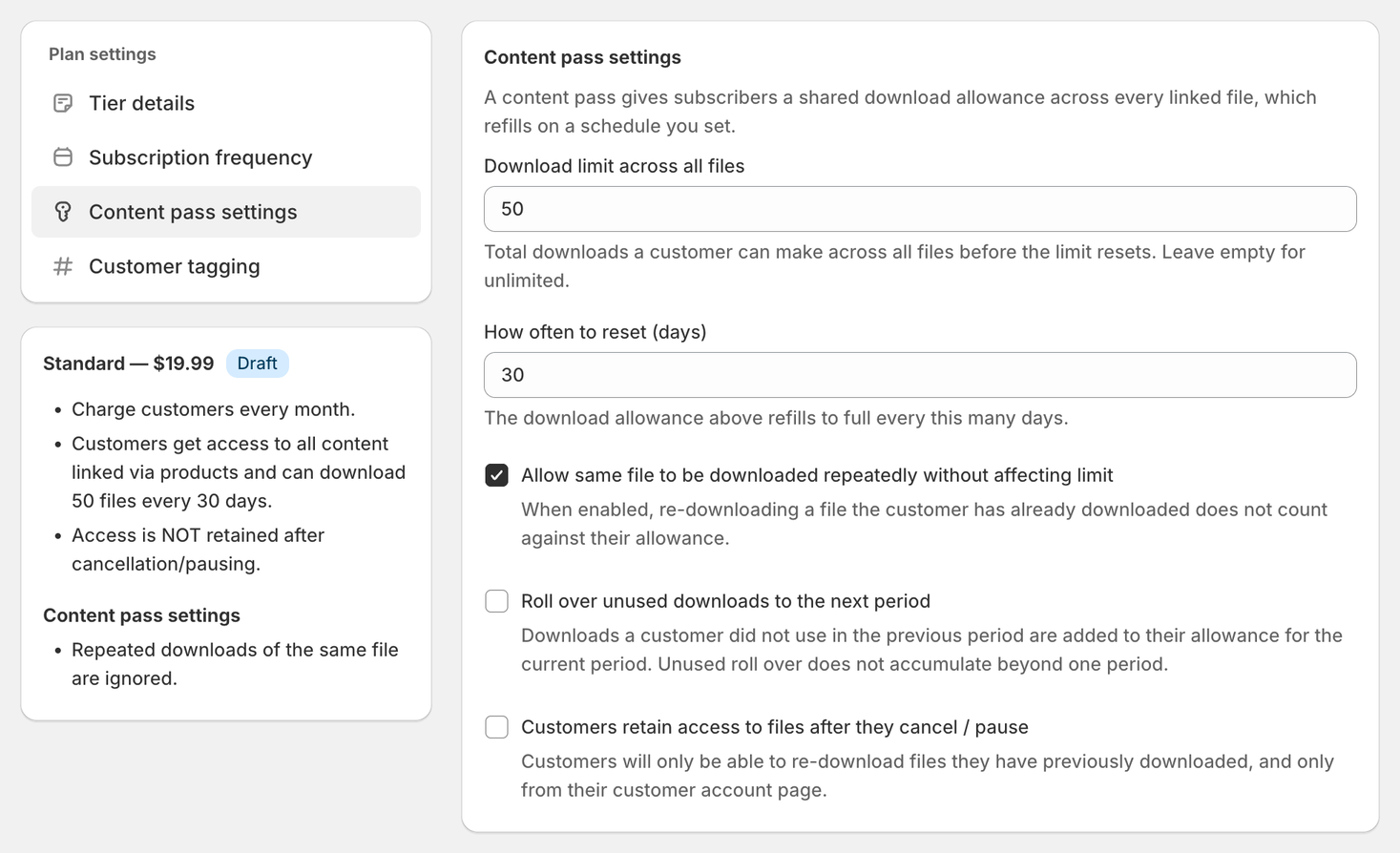
In the plan's Content pass settings:
- Download limit across all files: 5. Leaving it empty means unlimited downloads.
- How often to reset (days): 30, the default. The allowance refills to full every 30 days.
- Allow same file to be downloaded repeatedly without affecting limit: on by default. Leave it on, so downloading a pack again doesn't use up the allowance.
- Roll over unused downloads to the next period: optional. Unused downloads carry over, but only for one period.
- Customers retain access to files after they cancel / pause: off by default. Turn it on to let people who cancel keep re-downloading the files they already downloaded, from their customer account page.
Step 5: Save, Then Connect Your Packs
Click Save subscription, then Configure products in the dialog that opens. (Later, Digital Product configuration in the plan's Digital products panel opens the same page.) It lists every product in your store. Click a pack's product, then under Connected Files click Select files or Upload files to add the pack. Do this for each pack. Pass holders then get a download button on that product page.
One thing to watch: files are connected per plan. If you add a second plan later, such as a yearly one, connect your packs to it too, or its subscribers won't be able to download them. When you add new packs, connect each one to every plan that should include it.
Step 6: Turn On the Widget and Go Live
Check that the Subscription widget app embed is on, under Online Store → Themes → Customize → App embeds. That's what lets people subscribe on the pass's product page. Also make sure Shopify's customer accounts are on and Content Vault's checkout and customer account blocks are added, so subscribers can manage their subscription from their account. See Steps 4 and 5 in the install guide: turn on customer accounts and add the checkout and customer account blocks. Then click Set active on the plan and confirm.
The full walkthrough, with a screenshot of every panel, is in Setting up a Content Pass subscription. For an all-access membership instead, see Setting up a Library Access subscription, or Setting up a Content Drip subscription for a monthly pack club.
What the $15 Pass Costs to Run
Content Vault charges a fee on every successful subscription payment, including the first order. It's never charged on a failed payment. Here's what the fee comes to on one $15 payment, with each plan's storage:
| Plan | Plan price | Fee per payment | Fee on a $15 payment | Storage |
|---|---|---|---|---|
| Pay As You Go | Free to install | 4.95% + $0.25 | About $0.99 | 1 GB |
| Starter | $29/month | 1.95% + $0.15 | About $0.44 | 10 GB |
| Scale | $49/month | 0.95% + $0.10 | About $0.24 | 150 GB |
| Plus | $99/month | 0.50% | About $0.08 | 500 GB |
Shopify's own payment processing fee applies on top, as it does on any order. On fees alone, Starter works out cheaper than Pay As You Go once you take about 53 payments of $15 a month. Starter, Scale and Plus each come with a 10-day free trial.
For design assets, storage often decides the plan. Fonts and icons are small, but layered mockups, texture packs and 3D models add up fast. There's no limit on the size of a single file, only on your plan's total storage, and every plan has unlimited bandwidth. See How does Content Vault pricing work? for the full plan details.
How Subscribers Get Their Assets
With Content Pass, subscribers download from the product pages of the packs in their pass, and each new file they download counts against their allowance.
With Library Access and Content Drip, a new subscriber gets their download links in three places, all on by default:
- A download email when they subscribe
- The Thank You / Order Status page
- Their customer account
Each new Content Drip release also sends a New drip released email.
Any file type works. Upload fonts, brush sets, presets, LUTs, layered mockups, vector files, 3D models or a ZIP of a whole pack. Note that PDF stamping works on PDFs only, so fonts, images and other files go out without a stamp.
One pack, one file. On a Content Pass, every new file a subscriber downloads counts against their allowance. Put each pack in a single ZIP, and one download gets the whole pack.
Some assets are links, not files. A Figma UI kit, for example, is often shared as a link. A plan can deliver a link instead of an uploaded file.
Spell out your license. Subscribers need to know what they may do with your assets, such as using them in client work or in products they sell. Describe your license terms on the product page, or include a license file in each pack. Say, too, whether subscribers can keep using assets they downloaded once they cancel. If a pack includes someone else's work, such as a font inside a mockup, check that its license lets you resell it.
Updating a pack is easy. On the Files page, open the file and click Replace. The new version replaces the old one everywhere it's used. You can also tick a box to email a new download link to customers who downloaded the old file and still have access. See How to manage files.
Emails can match your brand. You can edit every email template and add translations. On Starter and up, emails can also come from your own email address.
How to Protect Your Design Assets
Once a file is on a subscriber's device, nothing can stop them from copying it. What you can do is make sharing harder. Content Vault gives you four layers.
1. A download allowance (Content Pass). Pass holders can download only so many new files each period. With 5 downloads every 30 days, nobody can download your whole catalogue in their first month and then cancel.
2. Download limits. On Library Access and Content Drip subscriptions, you can cap how many times each file can be downloaded (on every Content Vault plan). You can also cap how many IP addresses can download one subscriber's files (Starter and up). The IP limit is the main defense against a subscriber passing their download links around. Start generous, though: an honest subscriber might use a laptop, a tablet and a work computer. More in How to limit file sharing.
3. Fraud detection (Starter and up). The paid plans add the IP limit, the option to cancel a subscription when its payment retries fail, and holding orders that Shopify flags as fraud.
4. Access that ends with the subscription. Each plan has one setting for what happens when a subscriber cancels. Either they keep access to the files they already have, or they lose access when their paid period ends. Either way, they get no new ones.
There's no stamp for fonts, brushes or images, because PDF stamping works on PDFs only. None of these layers makes a file impossible to copy. Together, they make casual sharing harder.
What Each Plan Includes for a Design Asset Business
| Feature | Plan needed |
|---|---|
| Content Pass, Library Access and Content Drip | Every plan (Pay As You Go: up to 2 subscriptions) |
| Any file type, with unlimited bandwidth | Every plan |
| Download allowance (Content Pass) | Every plan |
| Download email, Thank You page and account links | Every plan |
| Download limit per file | Every plan |
| Analytics | Every plan |
| IP address limits and fraud detection | Starter and up |
| Emails from your own address | Starter and up |
| PDF stamping, for PDF files | Starter and up |
| Video streaming, for tutorial videos | Plus |
Tips for Keeping Design Asset Subscribers
- Add new assets on a schedule. A pass or a membership keeps its value when the catalogue keeps growing. Pick a rhythm, like a few new packs on the 1st of each month, and stick to it.
- Tell subscribers what's new. Turn on Tag customers on Shopify in a plan's settings, and each subscriber gets a
Subscribed - <plan name>tag. You can use it to email them when new packs land. - Make every pack easy to judge. Pass holders pick from your product pages, so clear previews, like a preset's before and after or a font set in a real layout, help them spend their allowance.
- Offer a yearly plan. It gives subscribers a reason to commit, and you get the year's payment up front. A yearly plan needs a fixed yearly price under Show advanced pricing options. Its allowance still refills on its own schedule, such as every 30 days.
- Launch with a discount. A plan that uses the product's price can take a percentage off for a set number of billing cycles, like 20% off the first 3 months. Fixed-price plans can't.
- Raising prices later. When you edit the price set on a plan itself, or the Shopify product's price behind a plan, like the Monthly plan's $15, existing subscribers keep the price they signed up at. New subscribers pay the new one.
- Try a free trial. You can also give new subscribers a free trial.
- Reward your best customers. On a pass holder's customer page, Extend limit gives them extra downloads for the current period, or for every future period.
- Watch your numbers. The Analytics page shows MRR, churn rate and your most-downloaded files on every plan, so you can see which assets to make more of.
Related Guides
- How to sell template and planner subscriptions: for planners, Canva templates and document templates
- How to sell ebook and PDF subscriptions: the same steps for a monthly club, with PDF stamping
- How to price a digital subscription: set a starting price, then check it against your fees
Frequently Asked Questions
Can I sell fonts, brushes and presets as a subscription?
Yes. Content Vault supports all file types, so you can sell fonts, brush sets, presets, LUTs, mockups, 3D models or ZIP packs. PDF stamping only works on PDFs.
How do download credits work?
With Content Pass, each pass holder gets a download allowance, such as 5 downloads every 30 days, that refills on its own schedule. Downloading a file again doesn't count by default, and you can let unused downloads roll over for one period.
Do subscribers get the assets I add later?
With Library Access, yes: files you connect to a plan later reach that plan's existing subscribers. With Content Pass, pass holders can download a new pack once you connect it to their plan, and it uses their allowance. With Content Drip, new packs go out as releases on your schedule.
What happens to a subscriber's files when they cancel?
You choose for each plan. Either they keep access to the files they already have, or they lose access when their paid period ends. On a Content Pass, keeping access means they can re-download the files they already downloaded, from their customer account page. They get no new assets either way.
How much storage do design assets need?
Pay As You Go includes 1 GB of storage, Starter 10 GB, Scale 150 GB and Plus 500 GB. Every plan has unlimited bandwidth, and there's no limit on the size of a single file. Fonts and icons are small, while layered mockups, texture packs and 3D models take far more room. Content Vault warns you at 80%. If you reach your limit, new uploads are blocked, but existing files keep working.
Can I also sell single packs?
Content Vault sells subscriptions only. For one-time sales, our sister app ABC Digital Downloads handles single downloads.
Related reading


Want to try Content Vault?
Turn your digital files into a recurring subscription on Shopify in minutes.