How to Sell Online Course Subscriptions on Shopify
Sell an online course on Shopify as weekly lessons, a library or a class pass: which one fits, a worked $29 setup, and how to deliver and protect each lesson.
By the Content Vault team

Most guides to selling courses on Shopify are about one-time sales. A student pays once, gets the whole course, and you start again with the next student. A subscription works differently. Students pay every month or every year, and in return they get lessons that unlock over time, a library of courses to dip into, or a set number of classes.
This guide shows how to sell an online course as a subscription on Shopify with Content Vault. It covers which subscription model fits your course, a full setup with a price, how students get their video and PDF lessons, and how to protect them. Each step says which Content Vault plan it needs.
Can You Sell Course Subscriptions on Shopify?
Yes. Shopify runs the checkout and takes each renewal payment. What it doesn't do on its own is decide which lessons a student can open, release new modules on a schedule, and end access when someone cancels. That's the job of an app.
Store owners usually solve this in one of three ways. Some install a course app that builds lessons into the store. Some link Shopify to a course platform outside it. Others join a subscription app to a download app, often with a third app to lock content when someone cancels, and then keep all of them in sync.
Content Vault does the billing, the lesson delivery and the access rules in one app. Each lesson is a set of files you upload: a video that students download or, on the Plus plan, stream, plus PDF workbooks, slides, audio or anything else. Students subscribe through your normal Shopify checkout and manage their subscription from their customer account page. On Content Drip and Library Access, you can also let them pause or skip.
Three Ways to Sell a Course as a Subscription
Content Vault has three subscription types. Each one suits a different kind of course business.
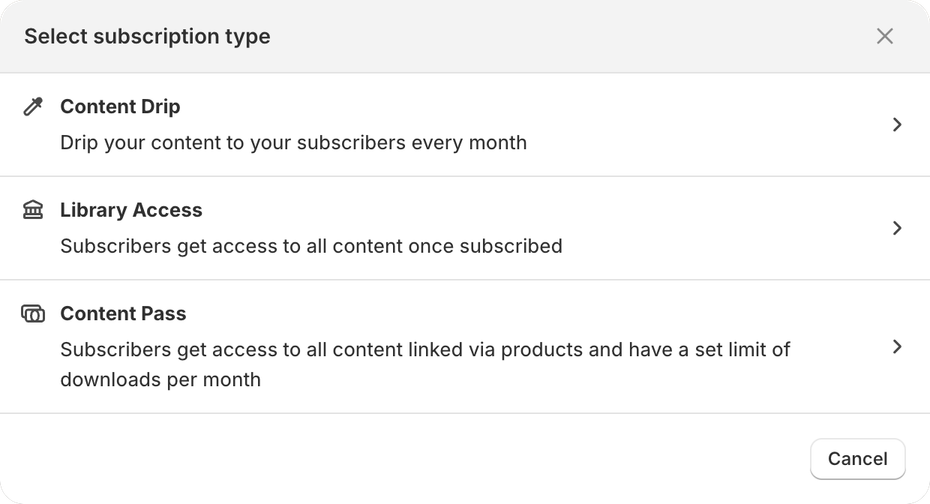
| Your idea | Content Vault type | What students get |
|---|---|---|
| A course that unlocks a module each week | Content Drip | New modules on a schedule, from their own start date |
| A library of all your courses | Library Access | Every course in their plan, right away |
| A class pass for a big catalogue | Content Pass | A set number of downloads that refills on a schedule |
A Course That Unlocks Week by Week: Content Drip
Content Drip releases new content on a schedule: every set number of days, such as every 7 days for a weekly module, or every month on a day you choose. Each release can hold a whole module, such as the video lesson and its worksheet. It fits:
- A 6- or 12-week course with one module a week
- A coaching or training program
- A skills course where each lesson builds on the last
- A monthly masterclass series
By default, every student starts at the first release and moves through the course from their own signup date. On a 7-day schedule, a student gets Module 1 the day they join, Module 2 a week later, and so on. Someone who joins a month after you launch still starts at Module 1. That's why drip suits courses that should be taken in order: nobody gets all 12 weeks on day one.
For a monthly series where everyone should get the same class, choose Every month and turn on Send content by month of subscription. Everyone then gets the same month's class, and new students don't get earlier months.
A Course Library: Library Access
Library Access gives students every file in their plan as soon as they subscribe. It fits:
- One monthly price for all your courses
- Recorded workshops and class replays
- Worksheets, templates and resources that go with your lessons
It also grows with you. A course you connect to the plan later reaches students who are already subscribed. You can sell levels too: a Basic plan with one course and an All-Access plan with every course, each with its own price and its own files.
A Class Pass: Content Pass
Content Pass gives students a download allowance, such as 4 classes every 30 days, across the classes you link to it. The allowance refills on its own schedule. It fits a big catalogue of short, standalone classes or lesson packs, where students pick what they want.
Content Pass has fewer settings than the other two. It has no per-file or IP download limits, and students can't pause or skip. If you want those, choose Content Drip or Library Access.
Not Sure? Run Two
You can run more than one subscription. For example, a weekly course for new students plus a library of your past courses. Pay As You Go, which has no monthly fee, allows two subscriptions, so you can test both. The help center's Which subscription type should I choose? compares the three in more detail.
How to Set Up a Weekly Course: A Worked Example
Say you teach watercolor painting. Your course, Watercolor Foundations, has 12 modules, and each module has a video lesson and a PDF worksheet. You want to charge $29 a month, and each student should get a new module every week, starting the day they join.
Step 1: Create the Product
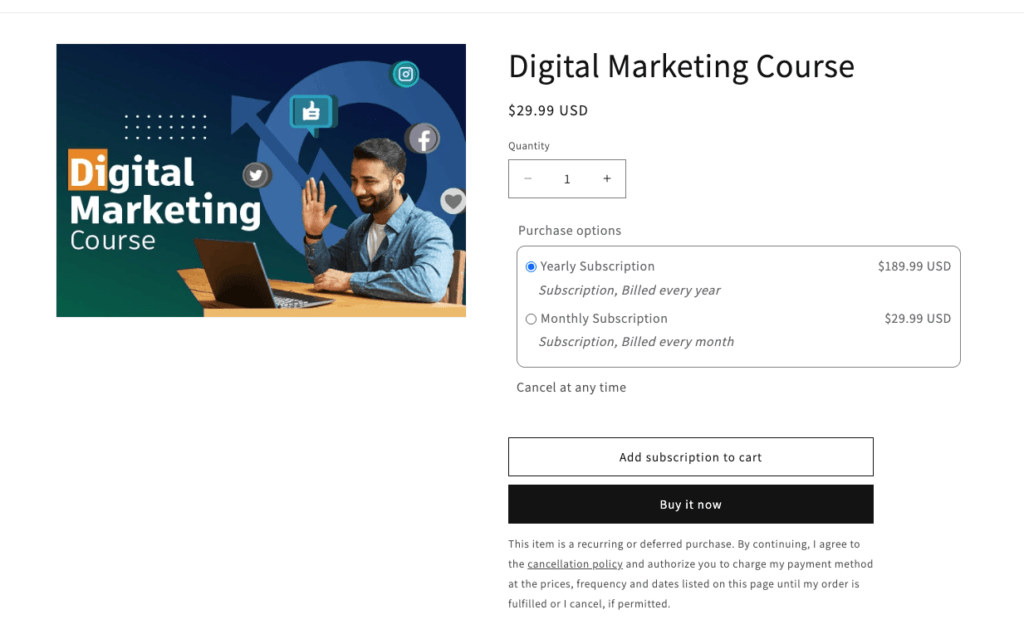
In Shopify, create one product for the course, such as "Watercolor Foundations", and give it a price of $29. One product is enough, even if you add a yearly plan later. Students pick their plan on the product page.
Step 2: Create a Content Drip Subscription
Go to Apps → Content Vault → Subscriptions and click Create new Subscription. (In your Shopify admin, Content Vault is listed as Digital Subscriptions.) Choose Content Drip. Give the subscription a name, which only you see, then click Select product and add your course product.
Step 3: Set Up the Plan
Each plan is a tier with its own name, price and billing frequency. Plan names are what students see, so keep them clear, like "Monthly". Set the Monthly plan to bill every 1 month. It uses the product's $29 price.
Billing and delivery are set separately, so students pay monthly and still get a module every week.
If students should commit to the whole course, set Minimum billing cycles to 3. A cancellation then takes effect only after three payments. The first checkout counts as the first payment. Say so on the product page. Leave the field blank for no minimum.
To end the subscription after a set number of payments, set Maximum billing cycles. Whether students keep their modules when it ends depends on the same setting that covers cancellations, under Customer options in Step 5.
You can add more plans later, such as a yearly one. Each plan shows up as an option on the product page.
Step 4: Set the Release Schedule
In the plan's drip settings, choose Every X days and enter 7. In this mode, new students always get the first release right away, so Module 1 arrives the day they join. After that, a new module arrives every 7 days, counted from each student's own start date. You can also set a delivery time and a timezone for releases.
Step 5: Choose Delivery and Protection Settings
Each plan has three more panels:
- Customer options: whether students keep their modules after they cancel or pause. Pause and skip are on by default.
- File delivery: a download email, links on the Thank You page and links in the customer account. All three are on by default.
- Download protection: optional limits, covered below.
Step 6: Save, Then Add Your Modules
Click Save subscription, then Configure drip content. Click Add Drip for each module. Give it a name students will recognize, like "Module 1: Materials and First Washes", add a cover image if you like, and attach the video and the worksheet with Select files or Upload files. The page saves as you go.
If you add a second plan later, add the modules to it too. Each plan has its own drip content.
Step 7: Turn On the Widget and Go Live
Check that the Subscription widget app embed is on, under Online Store → Themes → Customize → App embeds. That's what lets students choose a plan on the product page. Also make sure Shopify's customer accounts are on and Content Vault's checkout and customer account blocks are added, so students can find their lessons and manage their subscription from their account. See Steps 4 and 5 in the install guide: turn on customer accounts and add the checkout and customer account blocks. Then click Set active on the plan and confirm.
The full walkthrough, with a screenshot of every panel, is in Setting up a Content Drip subscription. For a course library instead, see Setting up a Library Access subscription, or Setting up a Content Pass subscription for a class pass.
What the $29 Course Costs to Run
Content Vault charges a fee on every successful subscription payment, including the first order. It's never charged on a failed payment. Here's what the fee comes to on one $29 payment:
| Plan | Plan price | Fee per payment | Fee on a $29 payment |
|---|---|---|---|
| Pay As You Go | Free to install | 4.95% + $0.25 | About $1.69 |
| Starter | $29/month | 1.95% + $0.15 | About $0.72 |
| Scale | $49/month | 0.95% + $0.10 | About $0.38 |
| Plus | $99/month | 0.50% | About $0.15 |
Shopify's own payment processing fee applies on top, as it does on any order. On Pay As You Go you pay nothing until you sell. Starter works out cheaper overall once you take about 30 payments of $29 a month. Starter, Scale and Plus each come with a 10-day free trial. If you want to stream your video lessons, you need Plus. See How does Content Vault pricing work? for the full plan details.
How Students Get Their Lessons
With Content Drip and Library Access, a new student gets their download links in three places, all on by default:
- A download email when they subscribe
- The Thank You / Order Status page
- Their customer account
Each new Content Drip release also sends a New drip released email, so students know the next module is ready. With Content Pass, students download from the product pages of the classes in their pass, and each new class they download counts against their allowance.
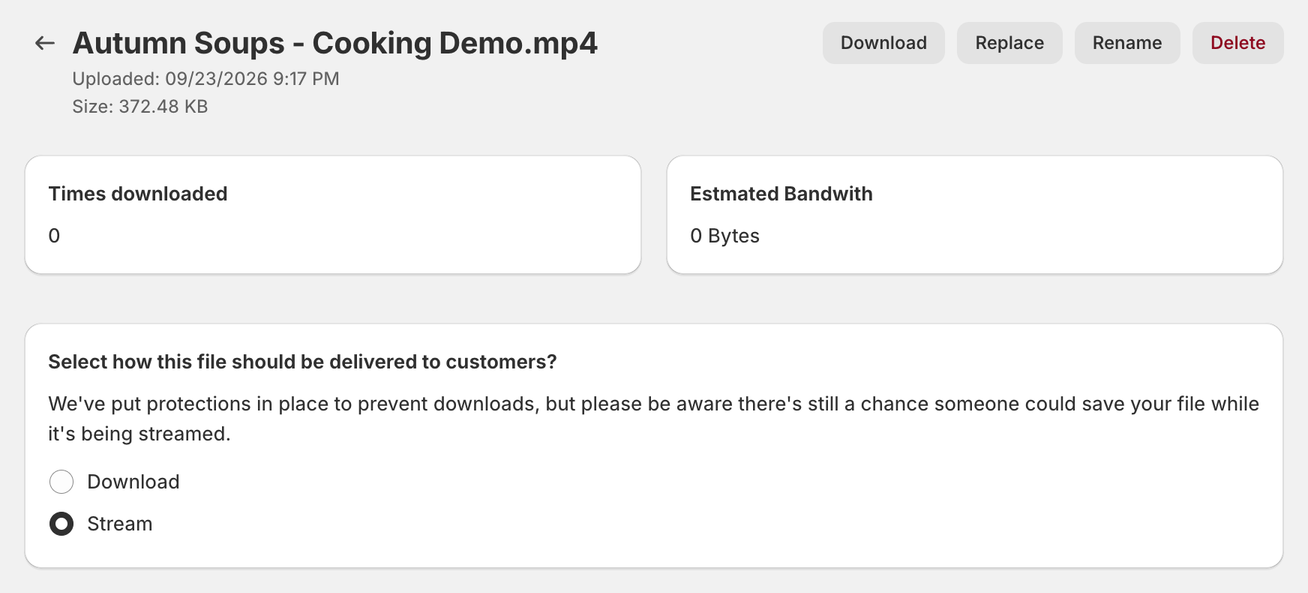
Videos can be downloaded or streamed (Plus). Every new upload starts as a download. On the Plus plan, you can set an MP4 or MOV video to Stream instead: open it on the Files page and choose Stream under Select how this file should be delivered to customers. Students then play the video online instead of downloading it. The choice saves as soon as you click it and applies everywhere the file is used. MP3 and WAV audio lessons can be streamed the same way. PDFs, ZIP files and other files are always downloads. See Setting up video / audio streaming.
Any file type works. Upload videos, PDF workbooks, slides, audio or ZIP files of project materials. A plan can also deliver a link instead of a file, such as a video lesson you host on Vimeo or YouTube. Note that PDF stamping works on PDFs only.
Updating a lesson is easy. On the Files page, open the file and click Replace. The new version replaces the old one everywhere it's used. You can also tick a box to email a new download link to customers who downloaded the old file and still have access. See How to manage files.
Emails can match your brand. You can edit every email template and add translations. On Starter and up, emails can also come from your own email address.
How to Protect Your Course Material
Once a file is on a student's device, nothing can stop them from copying it. What you can do is make sharing harder and riskier. Content Vault gives you five layers.
1. Streaming for video lessons (Plus). A streamed video plays in the browser instead of being downloaded, which cuts down casual sharing. It isn't DRM. As the app itself warns, someone could still save a video while it's being streamed.
2. PDF stamping for worksheets (Starter and up). Content Vault writes the student's details onto the PDF at the moment they download it. A stamp can use four variables: their name, their email, their plan's name and your store name. The stamp is visible text on the page. You choose its size, position, font, color and which pages it goes on. Your original file is never changed, and each student gets their own copy. Stamping works on PDFs under 100 MB.
Each template also has a Lock PDF option that tells PDF readers to block copying and printing. Treat it as a deterrent, since not every PDF reader honors it. The steps are in Setting up PDF stamping & watermarks.
3. Download limits. On Content Drip and Library Access subscriptions, you can cap how many times each file can be downloaded (on every Content Vault plan). You can also cap how many IP addresses can download one student's files (Starter and up). Streams don't count toward either limit. The IP limit is the main defense against a student passing their download links around. Start generous, though: an honest student might use a phone, a laptop and a work computer. More in How to limit file sharing.
4. Fraud detection (Starter and up). The paid plans add the IP limit, the option to cancel a subscription when its payment retries fail, and holding orders that Shopify flags as fraud.
5. Access that ends with the subscription. Each plan has one setting for what happens when a student cancels or pauses. Either they keep the modules they already have, or they lose access when their paid period ends. Either way, they get no new modules.
None of this is DRM, and a determined student can still share a lesson. For most course sellers, streamed videos and stamped worksheets do the most to stop casual sharing.
What Each Plan Includes for a Course Business
| Feature | Plan needed |
|---|---|
| Content Drip, Library Access and Content Pass | Every plan (Pay As You Go: up to 2 subscriptions) |
| Download email, Thank You page and account links | Every plan |
| Download limit per file | Every plan |
| Analytics | Every plan |
| PDF stamping for worksheets | Starter and up |
| IP address limits and fraud detection | Starter and up |
| Emails from your own address | Starter and up |
| Video streaming | Plus |
Tips for Keeping Students Subscribed
- Make Module 1 one of your best. Students decide early whether a course is worth paying for.
- Name every module. Your release emails can show each drip's name and cover image, and "Module 4: Wet-on-Wet Skies" says more than "Drip 4".
- Match the pace to the lessons. A weekly release suits a substantial module. Thin content every week wears people out. Our content drip marketing guide covers how to pick a schedule.
- Plan what comes after the last module. Students who finish need a reason to stay, such as a next course, follow-on lessons or a library of your past courses.
- Launch with a discount. A plan that uses the product's price can take a percentage off for a set number of billing cycles, like 20% off the first 3 months. Fixed-price plans can't.
- Raising prices later. When you edit a price set on a plan itself, or the Shopify product's price behind a plan, like the Monthly plan's $29, existing students keep the price they signed up at. New students pay the new one.
- Try a free trial. You can also give new students a free trial.
- Ask why people leave. On Content Drip and Library Access, students are asked for a cancellation reason by default. You'll find the reasons on the Customers page.
- Watch your numbers. The Analytics page shows MRR, churn rate and your most-downloaded files on every plan, so you can see which lessons land.
Related Guides
- How to sell ebook and PDF subscriptions: the same setup for a monthly ebook club
- Content drip marketing: how to plan a release schedule that keeps subscribers
- How to price a digital subscription: how to turn a one-time course price into a monthly one
Frequently Asked Questions
Can students start the course whenever they like?
Yes. With Content Drip, each student starts at the first module by default and moves through the course from their own signup date.
Can students stream video lessons instead of downloading them?
Yes, on the Plus plan. Set an MP4 or MOV file to Stream and students play it online. Streaming reduces casual sharing, but it isn't DRM.
What happens to a student's lessons when they cancel?
You choose for each plan. Either they keep the modules they already have, or they lose access when their paid period ends. They get no new modules either way.
Can I sell several courses in one subscription?
Yes. With Library Access, students get every course in their plan right away. A course you add to the plan later reaches students who are already subscribed.
How much storage does a video course need?
Video takes far more room than PDFs, so check your plan's storage. Pay As You Go includes 1 GB of storage, Starter 10 GB, Scale 150 GB and Plus 500 GB. Every plan has unlimited bandwidth. There's no limit on the size of a single file, only on your plan's total storage. If you reach your limit, new uploads are blocked, but existing files keep working.
Can I also sell the course as a one-time purchase?
Content Vault sells subscriptions only. For one-time sales, our sister app ABC Digital Downloads handles single downloads.
Related reading


Want to try Content Vault?
Turn your digital files into a recurring subscription on Shopify in minutes.